A rural education model that teaches rural development to rural children and helps them find local employment.
Rural children are taught to aspire to city jobs, and leave. GRAMODAYA teaches rural development to rural children instead, so they can build a future where they already live.
The model creates a backbone of rural development professionals based in rural areas, equipped to implement the welfare programmes of the government and other bodies. It uses a learning approach that is roughly 70 percent practical and 30 percent theoretical, covering every area of rural development relevant to the region.
After completing the programme, students can join government welfare projects, work with NGOs, or set up their own SERA Labs to drive local change. GRAMODAYA was piloted successfully in two villages of West Bengal, and received the HP Education Innovation Fund for India Award in 2013.
The two-year curriculum was devised by rural development professors from IRMA, TISS, IIFM and XIMB for rural adolescents. Each student gains expertise in two areas of rural development of their own choosing, and is mainstreamed through the National Institute of Open Schooling, so they leave with double certification from NIOS and GRAMODAYA.
Students choose any two, depending on local need:
The plan is a public private partnership, assisted by government departments, institutes, banks, NGOs and small businesses in the district, and managed by an advisory body of academics, practitioners and local administration. Land is allocated by the Panchayat or Gram Sabha. Each centre is set up with initial funding support and whatever schemes apply, and reaches self-sustainability over five years, with a revolving educational loan mechanism explored with banks, philanthropists and CSR to carry the cost of each child.
GRAMODAYA was piloted successfully in two villages of Bankura district, West Bengal, with SRREOSHI, an NGO founded by the Ashoka Fellow Shikha Roy and based in Durgapur. It received the Education Innovation Award in 2013 from the Education Innovation Fund for India, instituted by Hewlett Packard and the Sri Aurobindo Society.
Corporate houses, funding organisations, philanthropic groups and large NGOs can replicate GRAMODAYA in other regions and states through their partners. Local NGOs interested in piloting it with their own funding are welcome.
Ancient India, often called the Golden Bird, was known for a traditional, value based, skill based Gurukul approach to education. The Vedas and Upanishads remain testimony to the knowledge of that era. Although the country went through repeated cycles of disintegration into smaller states and integration into larger kingdoms, each cycle added something, and India absorbed many cultures while keeping the dignity of every profession high, so that every individual held a skill and a respectable livelihood. There were therefore no beggars and no thieves, as Lord Macaulay is said to have reported to the British Parliament.
After British rule the education system followed colonial patterns, pointing towards glamorous, package-rich, urban-centric professions and neglecting rural ones. In the name of universalisation, that same urban-focused education was then given to rural children too. Finding no relation between the content and their own context, most rural children see no future in competitive urban professions and drop out midway. The highest dropout rate comes after Grade 8.
Meanwhile, as the development sector grew, demand for rural development professionals appeared and premier business schools stepped in to supply them, with a minimum requirement of a graduate degree. The result was that urban graduates who could afford the fees became the rural development experts.
Since independence, rural children have received an urban-focused education and urban youth have received a rural development education. Ironic, isn’t it?
Rural children rarely study beyond school because they need to earn. With irrelevant education and no rural development skills, they leave for the cities. The determined few who pursue higher education also move away to practise. Rural development programmes then fail to be implemented properly for want of skilled people locally, while professionals from business schools, with little rural grounding, absorb a large share of the funds as salaries and perks. Villages lose their self-sufficiency and slowly die of migration.
If rural development has such employment potential, why do rural youth migrate for work? Why can’t rural children be educated in rural development, so they can earn a living by building better infrastructure and facilities where they already are? That question is what GRAMODAYA answers.
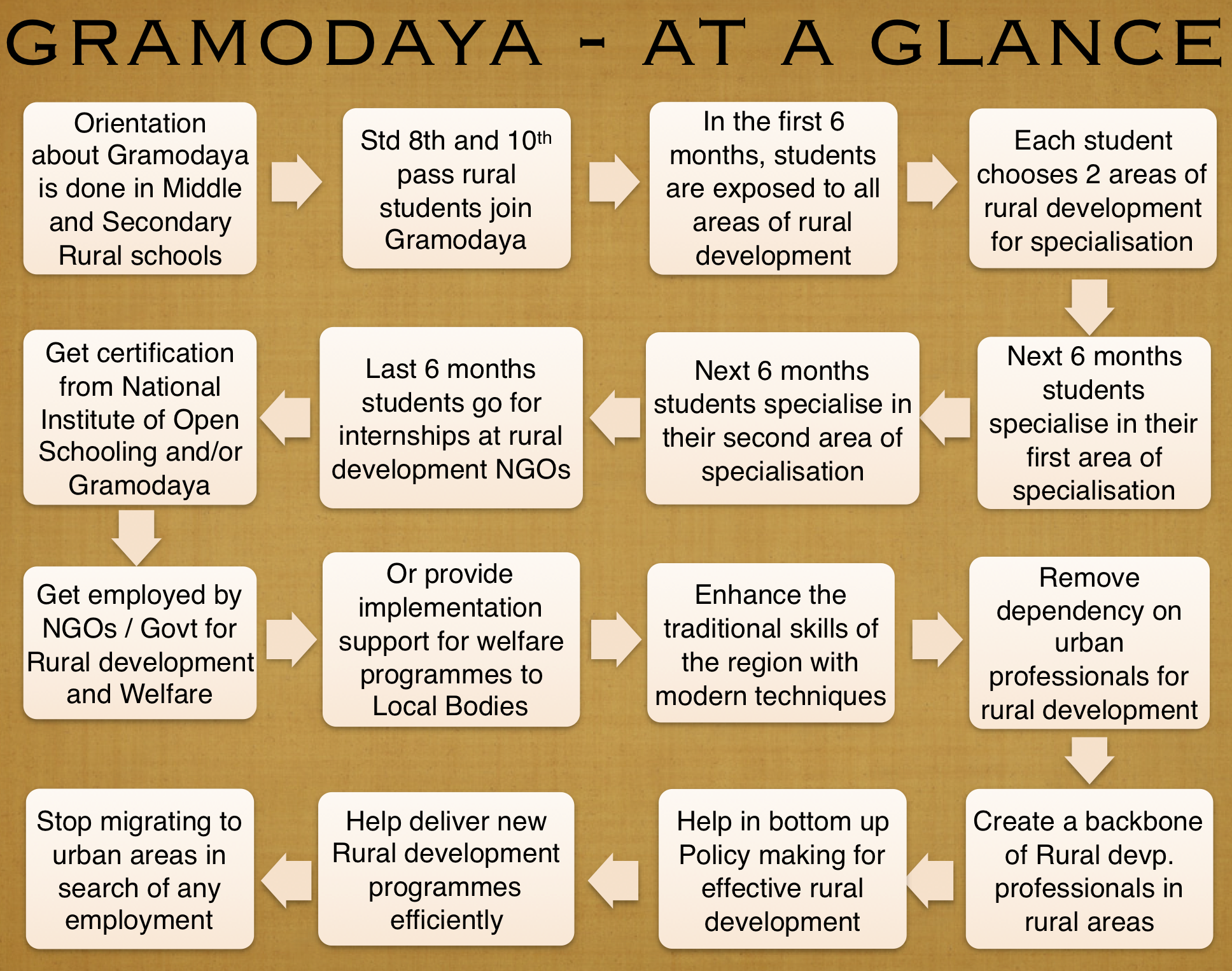
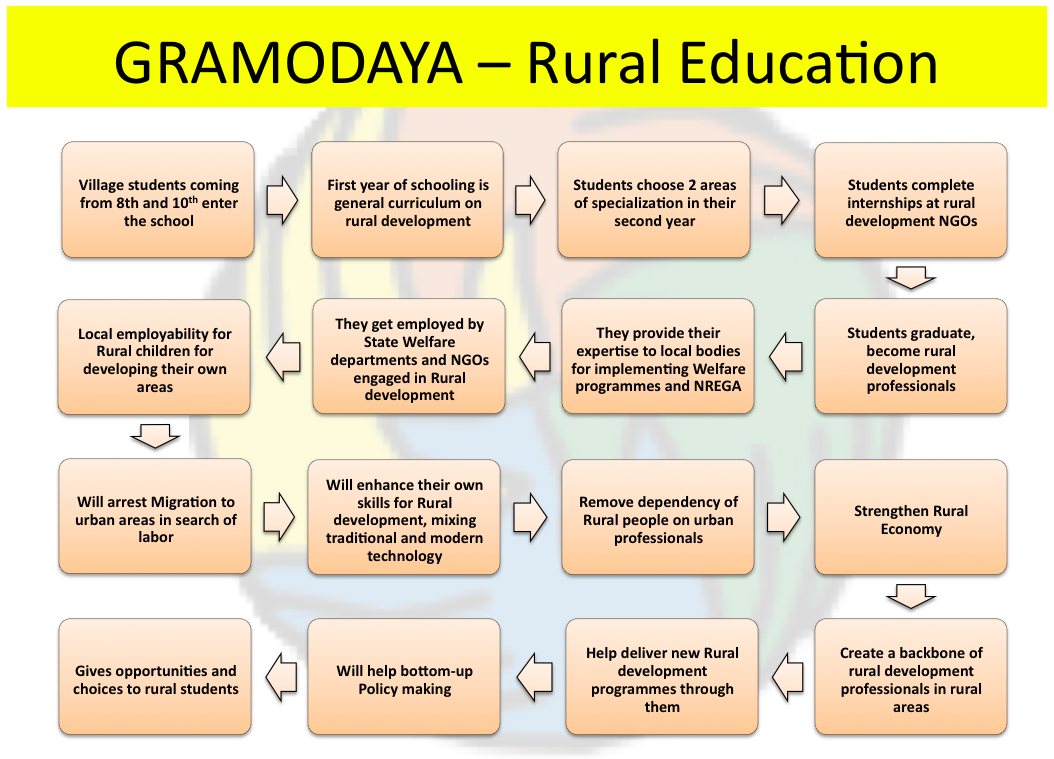
The path a rural student takes from a school orientation talk to a rural development career at home.
Orientation about Gramodaya is run in middle and secondary rural schools.
Students who have passed Std 8 or Std 10 join Gramodaya.
In the first six months they are exposed to every area of rural development.
Each student chooses two areas to specialise in.
The next six months are spent specialising in the first chosen area.
The following six months are spent specialising in the second.
The last six months are an internship with a rural development NGO.
Students are certified by the National Institute of Open Schooling and by Gramodaya.
They are employed by NGOs or government for rural development and welfare.
Or they provide implementation support for welfare programmes to Panchayats and local bodies.
They enhance the traditional skills of their region with modern technique.
Dependency on urban professionals for rural development falls away.
A backbone of rural development professionals is created, living in rural areas.
They help make policy from the bottom up, so it works on the ground.
New rural development programmes get delivered efficiently, and the rural economy strengthens.
Young people stop migrating to the cities in search of any work they can get.
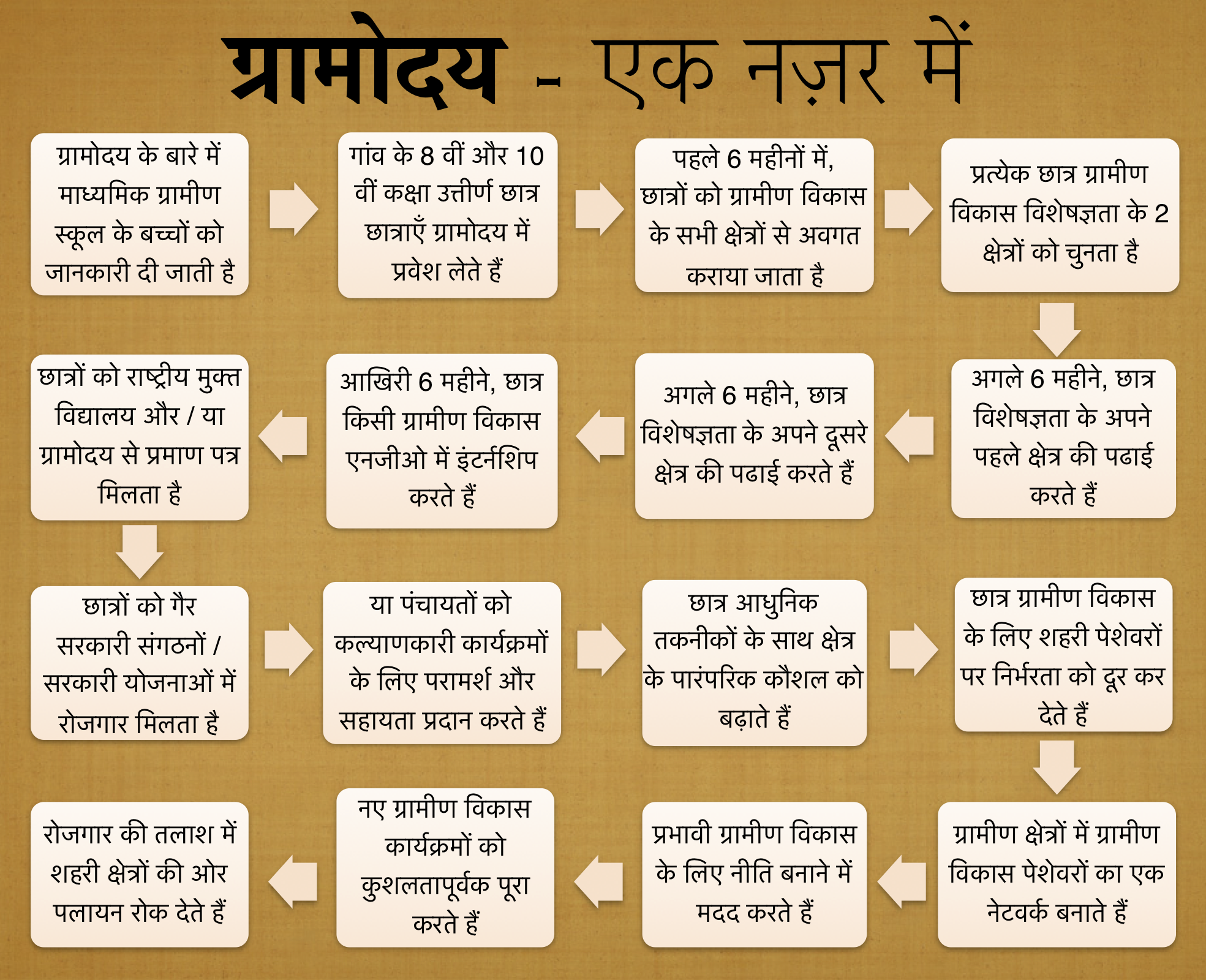
ग्रामोदय के बारे में माध्यमिक ग्रामीण स्कूल के बच्चों को जानकारी दी जाती ह
गांव के 8वीं और 10वीं कक्षा उत्तीर्ण छात्र छात्राएँ ग्रामोदय में प्रवेश लेते हं
पहले 6 महीनों में, छात्रों को ग्रामीण विकास के सभी क्षेत्रों से अवगत कराया जाता ह
प्रत्येक छात्र ग्रामीण विकास विशेषज्ञता के 2 क्षेत्रों को चुनता ह
अगले 6 महीने, छात्र विशेषज्ञता के अपने पहले क्षेत्र की पढ़ाई करते हं
अगले 6 महीने, छात्र विशेषज्ञता के अपने दूसरे क्षेत्र की पढ़ाई करते हं
आखिरी 6 महीने, छात्र किसी ग्रामीण विकास एनजीओ में इंटर्नशिप करते हं
छात्रों को राष्ट्रीय मुक्त विद्यालय और / या ग्रामोदय से प्रमाण पत्र मिलता ह
छात्रों को गर सरकारी संगठनों और सरकारी योजनाओं में रोजगार मिलता ह
या पंचायतों को कल्याणकारी कार्यक्रमों के लिए परामर्श और सहायता प्रदान करते हं
छात्र आधुनिक तकनीकों के साथ क्षेत्र के पारंपरिक कौशल को बढ़ाते हं
छात्र ग्रामीण विकास के लिए शहरी पेशेवरों पर निर्भरता को दूर कर देते हं
ग्रामीण क्षेत्रों में ग्रामीण विकास पेशेवरों का एक नेटवर्क बनाते हं
प्रभावी ग्रामीण विकास के लिए नीति बनाने में मदद करते हं
नए ग्रामीण विकास कार्यक्रमों को कुशलतापूर्वक पूरा करते हं
रोजगार की तलाश में शहरी क्षेत्रों की ओर पलायन रोक देते हं
Helps rural youth redesign sustainable local livelihoods together as climate change and automation erode farming and factory work, keeping communities and ecology intact.
A shared platform that brings community, university, corporate and government together to brainstorm and test solutions for long pending problems, at both grassroots and university level.
Builds critical thinking, awareness and empathy through everyday, experience based learning, the skills today's exam driven schooling tends to leave out.
Whether you bring funds, a fresh idea, or an unsolved problem from the community you serve, there is a way in.