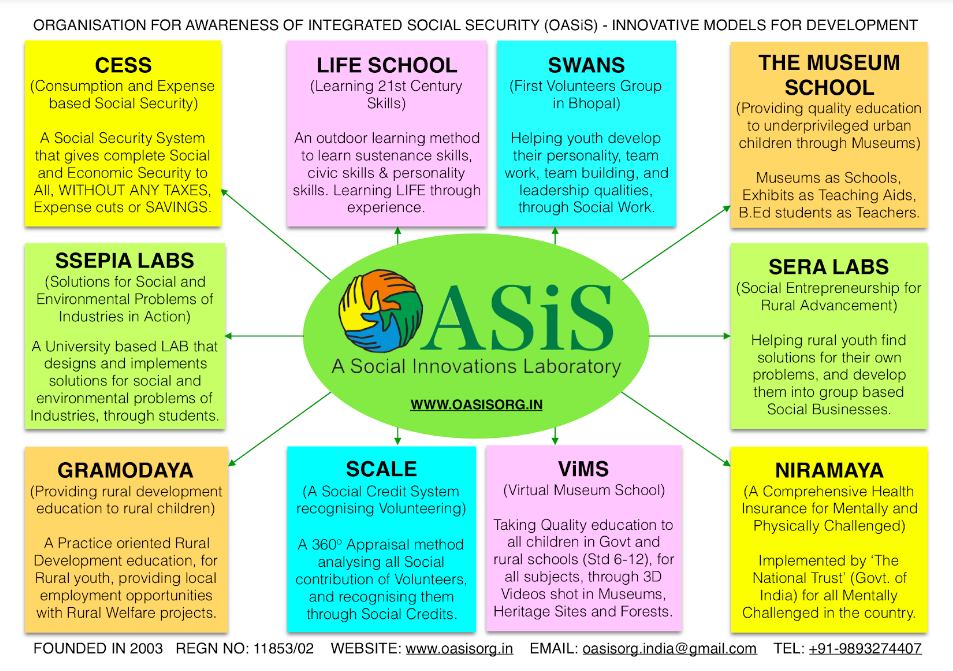
Since 2003 the lab has produced ten models, acclaimed nationally and internationally. Each began as a problem on the ground. Explore any of them in detail.
A shared platform that brings community, university, corporate and government together to brainstorm and test solutions for long pending problems, at both grassroots and university level.
Complete social security for the masses with no taxes, premiums or savings, drawn from a slice of each family's everyday spending. The first expenditure based model in the world.
Turns city museums into schools and their exhibits into teaching aids, with B.Ed. trainees as teachers, giving slum children world class education at almost no extra cost.
A campaign begun in 2005 led to India's first national health insurance framework for the disabled, co-designed with the Chief Commissioner Disability, The National Trust and IRDA.
An on field finishing school that grows teamwork, leadership and compassion in young people through social work, shaping them into responsible, capable citizens.
A 360 degree system that scores social contribution and awards credits, mobilising youth, institutions and corporates toward volunteering and rewarding responsible action.
Teaches rural development to rural children, 70 percent practical and 30 percent theory, building a local backbone of professionals to run welfare programmes and earn locally.
Builds critical thinking, awareness and empathy through everyday, experience based learning, the skills today's exam driven schooling tends to leave out.
Turns a classroom into a 3D theatre and a lesson into a 3D film, giving every child a personal teacher and exhibits that pop off the screen, anywhere in the world.
Helps rural youth redesign sustainable local livelihoods together as climate change and automation erode farming and factory work, keeping communities and ecology intact.
Connects urban professionals who want purpose and nature with rural youth who need new economy skills, a two way bridge toward a society with less deprivation and division.
A venture mentored at the lab that captures positive news from around the world, on the belief that if bad news drives bad action, good news can drive good action.
India has held developing country status for decades without becoming a developed one. What is missing? The skills and resources for real development, or the habit of depending on government to supply them?
Until recently the Indian working world had only blue collar and white collar professionals. Globalisation has added collars of every colour, gold, green, red, purple, pink, black, grey, silver, open, new, and now steel. Unfortunately all of those new skills and professionals are confined to urban areas.
Rural youth need many of these new skills to manage their work and their lives better, but no bridge exists to carry the skills to them. At the same time, urban professionals long to breathe in an open, nature-filled environment and to do something for society and the environment that satisfies them, yet not all of them have the resources, or a strong enough sense of purpose, to act.
Matching the needs on both sides, Good-to-Go creates a bridge with a purpose, driving skill sharing and the experience of nature between urban professionals and rural youth, with the objective of an equal society free of deprivation and discrimination. It is being piloted in a few areas, and a dedicated website is under development.
In a world where rape, crime, murder and accident dominate the news industry, there is very little room to show the good that is happening. For most people no news is good news; in today’s media, good news is no news. Young people are misled by the negativity around them and lose confidence in themselves, in the system and in society.
The Optimist Citizen is a newspaper that captures positive news from around the world and presents it every fortnight, in the hope of burying the negative and sensational reporting that creates hopelessness and fear. Its founding belief is simple: if negative news can stimulate negative action, positive news will stimulate positive action.
It received the Manthan e-Journalism Award in 2015 and the Ashoka Youth Venture Fellowship in 2015, and was listed in Forbes 30 Under 30 Asia in 2019.
A single-sheet overview of every OASiS innovation, for printing or sharing.
Whether you bring funds, a fresh idea, or an unsolved problem from the community you serve, there is a way in.