
The early years, 2005 to 2007
The first eighteen months of Parvarish, when the numbers fell from fifty to twenty before they started to climb.
Urban slum children who have never been to school, or who ran away from it, jumping around with joy in an environment of knowledge and learning.
Using experiments and science models as toys. Swinging in the rain among trees. Using the colours of leaves and flowers to paint the world, writing on a slate of sand, playing with pebbles to learn mathematics, dropping them into water to understand how sound travels, playing treasure hunt in tribal habitats to understand culture and architecture. That is Parvarish, the Museum School.
Getting started
Tiny feet bruised by glass, walking bare on hot tar roads, a back full of garbage, hardly a meal in a sunken belly, and local drugs to dull it. That was the everyday sight in the ragpicker colonies. Neither the Sarva Shiksha Abhiyans nor the mid-day meals could pull these children away from that grind.
OASiS took it up as a challenge and went looking for another route to bring them into the mainstream. The search led to Shantiniketan, to the Aurobindo Ashram's International Centre of Education in Pondicherry, and to several other non-formal models. Combining their best practices into a curriculum meant to transform the whole child, OASiS partnered three Bhopal museums to build a new environment for learning. Built on the belief that nature is the best teacher and exposure is the best learning, Parvarish began on 5 September 2005.
The initial days
As we picked our way through filth and garbage to reach their homes and register children aged five to ten, we met a great deal of abuse from drunken fathers who assumed we were there to take away their child's earnings. Fifty came on the first day. It may have been only a picnic to them, because the number soon fell to twenty.
But as the teachers cared for each child, cleaning them, combing them and showing them their own reflection, the children began to change visibly in appearance, cleanliness and behaviour. The sudden exposure to a strange, knowledge-filled place, the warm company of well-groomed adults, and a new world of letters and numbers were enough to shift their personalities. As the children carried the learning home, the abuse turned into appreciation and the numbers began to swell. Starting with twenty children from one slum, the project reached seventy children from three slums in eighteen months.
A day at Parvarish
A typical day starts at 2pm, when the teacher volunteers fan out to their allotted slums to collect the children. This gives them a chance to meet the families and ask after them. The children walk with the teacher to the bus stop, describing their morning at home or at work along the way.
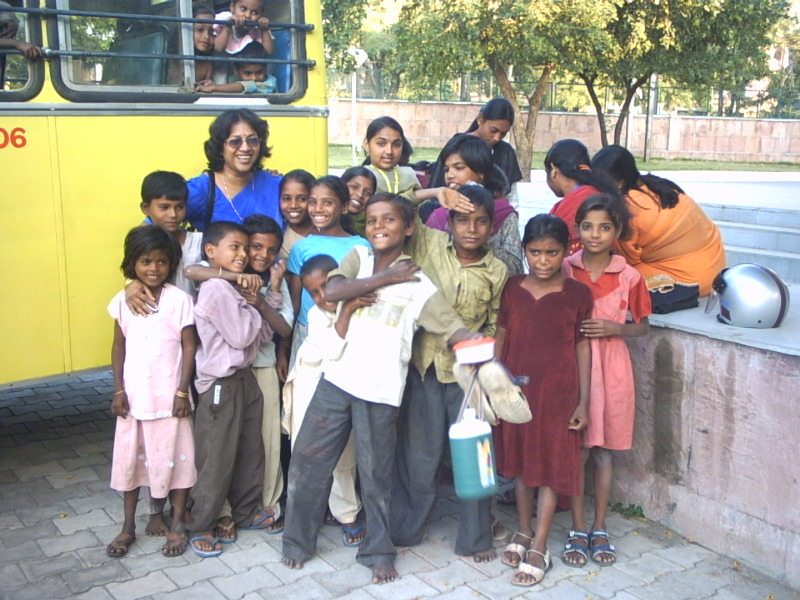
The bus fills with greetings and giggles as it picks up children from three slums and glides through the traffic. At the museum, the children fall into line, disciplined and well mannered, for the prayer song. Then they separate into groups by age and are led to different spots.
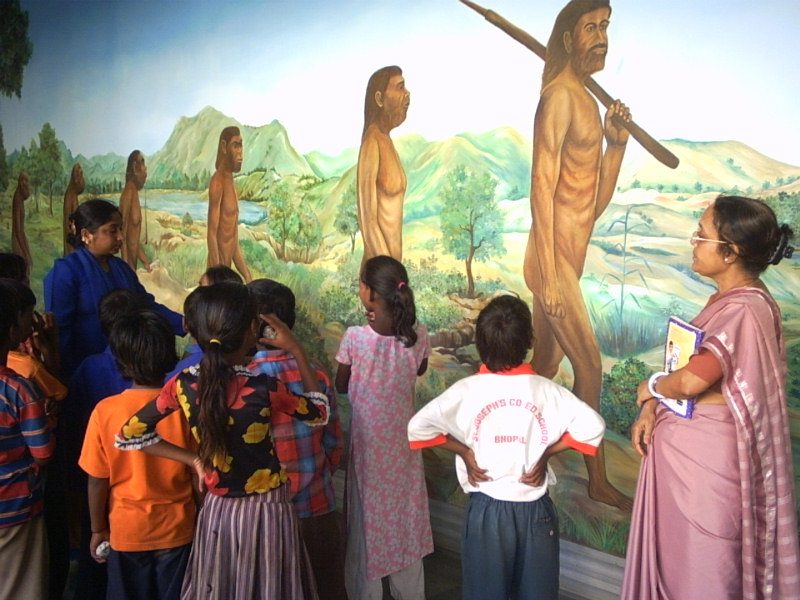
The teachers run their sessions using objects from nature, teaching through games. The session is followed by a group meal, and then it is time to roll on the grass and play. Every passing commuter knows the return trip, because the bus resonates with the children singing. Then home, to share what they learned that day.
The year that went by
The year began with behavioural change, with games and competitions around cleanliness and discouraging the gutka habit. Letters, words and numbers came in alongside colours, fruits, flowers, birds and animals. As the children learned to draw and colour, they also learned to write names and add numbers. They used stone slabs and levelled sand as slates, and crushed flowers and leaves into colours. Thumbprints and flick sprays brought their imagination onto paper and leaves.
Learning multiplication tables was as much fun as singing. Poems found their music as the children hummed on swings. Physical exercise became dance steps. Science models became objects of magic that the children discovered for themselves, and as the explanations followed, myths came apart and questions came up from those little minds that left everyone spellbound.
Milestones in eighteen months
By the end of the period the children had learned:
- To read simple text and paragraphs in Hindi and English
- To write simple words and sentences in both languages
- Basic mathematical operations
- The five senses and the anatomy of the body
- The basics of science, environment, evolution and habitat
- Terracotta and clay modelling: in their own words, a new way to play with mud
- Handicrafts, paper crafts and card making
A message from the children
The children of Parvarish wanted to thank their teachers for showing them a new way of life, and everyone whose support helped them understand the world and get an education like everybody else. They wanted to thank the people who gave them respect in a world that mostly shuns them, and their bus uncle, who takes them to school just like the privileged children. And they wanted to say that there are many more like them who need the same support and grooming, so that they too can grow up to be like you.