
The journey
How a chance meeting at a bus stop in January 2005 turned into a school that a UNESCO jury would recognise eleven years later.
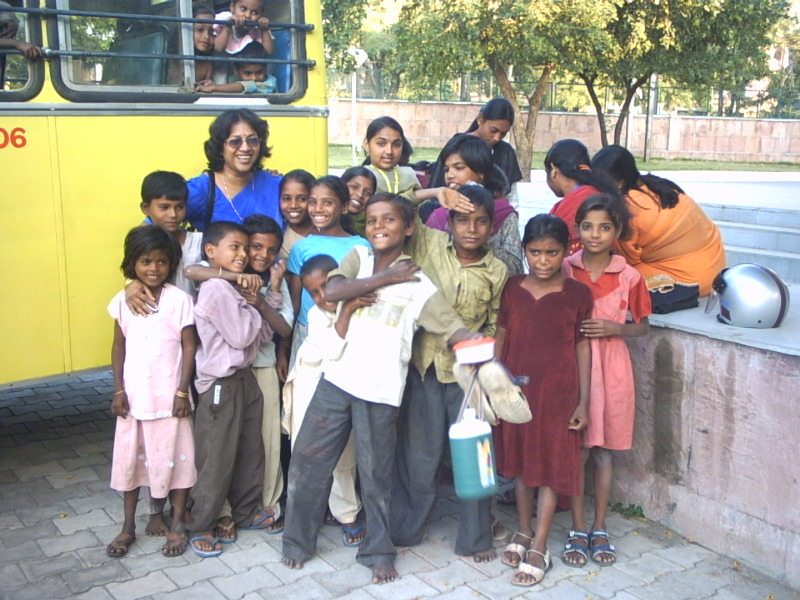
It started on a bright sunny day in January 2005, when we accidentally met a group of ragpicker children standing at a school bus stop in a posh residential colony in Bhopal.
In tattered clothes and bare feet, the five of them stood watching gleeful children get down from the bus and run to their waiting mothers. The only thing the two groups had in common was the bag on their backs. One held books and a tiffin. The other held garbage collected from the backyards of those same houses.
What struck us was the sparkle in their eyes as they watched their more fortunate counterparts come home from school. Those innocent minds did not question the difference. They only wished for a similar life.
We followed them back to their colony. Instead of waiting mothers there were fathers who greeted them by snatching away the rag bags. With the rags sold, the men went off to buy drink, leaving the children to fend for themselves. When we asked the children what they wanted to be, they shouted in unison that they wanted to be policemen. When we asked whether they would study for it, the answer was a much louder no.
What we found when we asked why
Today's education system has become a rote-learning factory, grinding out uniform results without understanding and popping out degrees like popcorn. A mouthful gets you nothing and a handful is not enough. On top of that, the cost of higher education puts it out of reach of the poor entirely.
It is not freebies but the assurance of work that draws children to education. In rural areas and urban slums, theoretical education is widely considered a waste of time that leads nowhere, and faith in the system's ability to produce a job is dwindling.
Education is the foundation of a country and every individual has a fundamental right to a good one. Yet in the same city the quality of education given to a rich child and a poor child differs enormously. If the foundation itself is unequal, how can anyone dream of an equal country?
The search
We travelled the length and breadth of the country looking for a holistic education model. Picking up principles from Rabindranath Tagore's Shantiniketan, the Aurobindo Ashram's International Centre of Education, the Rishi Valley schools and the Japanese education system among others, we tried to design a curriculum that could carry an impoverished child all the way to independent, responsible adulthood.
The next challenge was to put that curriculum into practice in the best possible learning environment, without any extra infrastructure or investment, and in a form cheap enough for others to copy later. The search took us to the museums, where treasures of knowledge lay practically unused, mostly serving as tourist attractions. Looking at the exhibits and working models as tools of learning rather than objects of display, it dawned on us: why can't this be the school?
The Museum School, named Parvarish, was launched on 5 September 2005 in collaboration with three Bhopal museums, with 40 ragpicker and working children from two slums.
How the school actually runs
The model uses the museums as schools, the exhibits and working models as teaching aids, and collaborates with B.Ed. colleges whose students do their practice teaching here. The curriculum runs from behavioural change to literacy, on to academics, physical and adolescence education, and finally to vocational skills and entrepreneurship. Children are mainstreamed through the National Open School for certification, but the real objective is to make them self-employable, confident, responsible and independent.
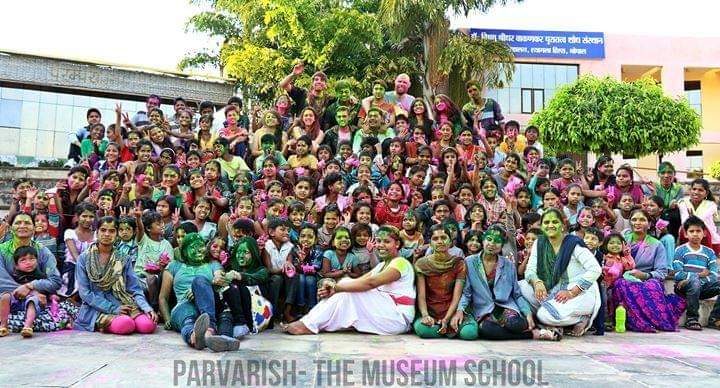
The journey that started with 40 children from two slums has reached 200 children from eight. The school runs daily in different museums from 3pm to 5pm, with subjects ranging from craft to museum-based teaching, taught by teachers, B.Ed. students and college volunteers. Children join between the ages of five and ten, and leave at sixteen ready to face the world. During their years here they pass through four stages, Nanha, Bachpan, Khilen and Yauwan.
What makes the school work is its fit with the realities of slum life. These children are earning members of their families, which is exactly why they stay away from regular schools. By running from 3pm, the Museum School avoids their working hours. By taking them out of the slum, it avoids interruption.
Nature plays a large role, following Tagore's principle that nature is the best teacher. Our children learn by asking questions. The curriculum covers language, mathematics, values, life skills, academics, physical education, adolescent education and vocational education. Science, social studies and environmental studies are taught from the working models and exhibits themselves. Through the year the children also learn the joy of hand skills (art, craft, sewing, stitching) and of dance, drama, music and yoga.
In the words of the parents
Rukhsana Begum, of Sai Baba Nagar, has ten children and sends every one of them to Parvarish. She says that once children go to school, their future is made. She finds the Museum School far more convenient and comfortable than the municipal school, and says the environment there is warmer and more motherly, so the children find it easier to express themselves.
Rakesh Kumar, of Shyam Nagar, says the school lives up to its name, parvarish means upbringing, and he feels the upbringing is real. He was struck by the change in his ten year old, who once could not speak on a stage and now speaks at the function every year.
The road has begun, but the goal is far
Like any innovation, the Museum School was struck down at first by pessimists who were sure it would do the children no good. So were the illiterate parents, who equated education with school bags, books and homework. We set out to prove both wrong, and followed two radical approaches: start literacy through play and education through museum exhibits at the same time, without books; and make school so attractive that a child longs to come.
Today, watching confident children walk onto the stage, we feel we are halfway there. Two of our 200 have joined undergraduate engineering courses. Some appear every year for Class 10 and Class 12 National Open School examinations. Others become independent on the hand skills they learned here. And as we tread the road we carved, other roads meet ours, partners in Bangalore, Mysore, Mumbai and Delhi adopting the model for slum children in their own cities.
None of this would have happened without the relentless effort of the teachers, the unconditional support of our sponsors and funders, and the volunteers of SWANS, who put their hearts into the project and became the children's favourite companions.
A waiting list of 250 children is the truest testimony to the impact. And as our partners carry the concept forward, we can see a movement building, one that will prove to the government that quality education need not come at a price, if existing resources are used well.
Long live the Museum School.