
SEPICA Labs, for universities and institutes
Social and Environmental Problems of Industries and Communities, addressed through Academics. A turnkey framework that turns a university into a working laboratory for the problems industry does not talk about.
The gap this closes
Universities everywhere prepare students for industry, and they do it well on the technical and commercial side. Corporate houses running seminars on campus showcase their achievements. But every industrial setup, wherever it sits, has social problems with the community around it and a long list of environmental issues. Those never make it into the lecture hall.
The other half of the problem is that students get theory and almost no chance to test it on the ground. Internships expose them to a fraction of the work. They graduate, join an industry with no real experience, and the company spends considerable time translating their theory into practice. Once inside, new recruits are not encouraged to experiment; they follow instructions.
They then perform well on every technical and commercial measure, meet their targets, and climb. And when they finally reach decision-making level, they are suddenly confronted with the social and environmental issues of the business, having never been taught anything about them. With a profit-first reflex and no grounding, they make whimsical decisions that make those issues worse. This has been going on since the industrial revolution.
Air pollution is one visible result. Of the thirty most polluted cities in the world, twenty-one were in India in 2019, and industrial pollution accounts for slightly over half of it. Air pollution contributes to around two million premature deaths in India every year.
Isn't it the responsibility of a university to prepare its students on all four aspects (technical, commercial, social and environmental) for both the corporate world and society? Industry would welcome graduates who are experienced, sensitive to the community and environment, and able to act responsibly.
How a SEPICA Lab runs
Six stages, each with defined roles for students, faculty and the partner industry.
1. Formation
- The university allocates an existing physical space on campus for meeting and brainstorming.
- The formation of the lab is announced to students and faculty.
- An Innovation Jam is held over a weekend to launch it.
- Students register with the lab, listing their areas of interest and existing skills.
2. Research
- The university identifies one or two industries as the focus for the year.
- Interested students form need-assessment groups.
- One group goes into the industry to find its social and environmental problems.
- One group goes into the community around the industry to find its socio-economic problems.
- Two groups fan out into the surrounding environment to assess environmental change.
- The groups bring their findings to one table and map the relationships between them, which identifies the trouble spots.
- Each trouble spot becomes a project carrying academic credit.
3. Design
- Each project is led by one professor, which counts towards their research work and appraisal.
- Each research group nominates one member to a Project Core Group, with a two-year term.
- The lead faculty and core group build the solution framework and split it into modules.
- Core group members take their modules back to their own research groups to innovate solutions.
- The module solutions are stitched into one integrated solution.
- Projects are proposed to the industry for CSR funding, since they solve that industry's own problems.
4. Implementation
- Projects are floated to all students and faculty.
- Students apply according to interest and knowledge.
- Research groups interview and select students to enlarge the implementation teams.
- Solutions are implemented by the project groups, funded by the industry.
5. Evaluation
- An expert panel, including an industry representative, assesses each research group's work and the project overall.
- The panel assigns credits to each research group, and an overall credit to the project.
- Group credits pass to the students in that group.
- The overall project credit adds to the lab's performance and to the lead faculty's profile.
6. Operation
- The lead faculty of all projects form the lab's Core Management Team.
- That team creates an Operations Team for logistics, accounting and the rest, also carrying credit.
- Operations vacancies are floated to students, who join and add the credit to their totals.
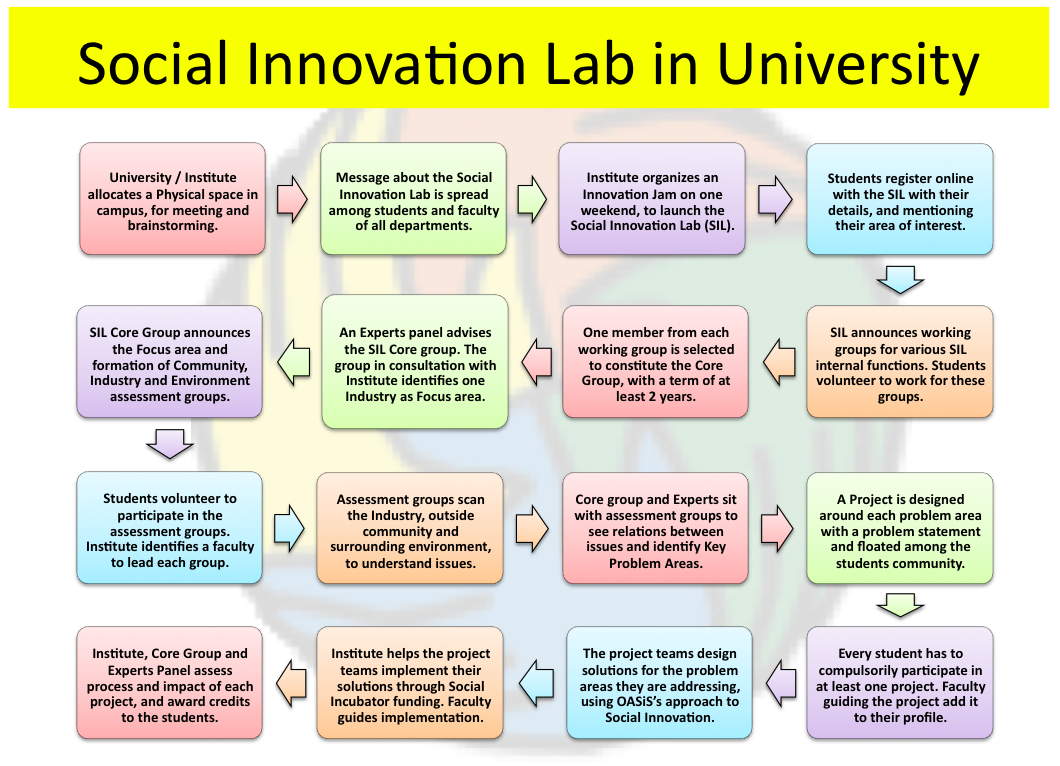
The same six stages, in sixteen steps
A summary you can print or share, covering the same ground as the stages above.
Standing the lab up
The university allocates a physical space on campus for meeting and brainstorming.
The lab is announced to students and faculty across all departments.
The institute runs an Innovation Jam over a weekend to launch it.
Students register online with their details and areas of interest.
Governing it
The lab announces working groups for its internal functions, and students volunteer for them.
Each working group selects one member to the Core Group, for a term of at least two years.
An experts panel advises the Core Group, which with the institute identifies one industry as the year’s focus.
The Core Group announces the focus area and forms Community, Industry and Environment assessment groups.
Finding the real problems
Students volunteer for the assessment groups, and the institute assigns a faculty member to lead each.
The groups scan the industry, the surrounding community and the environment to understand the issues.
Core group and experts sit with them to map the relationships between issues and identify key problem areas.
A project is designed around each problem area with a clear problem statement, and floated to the student body.
Solving and crediting
Every student must take part in at least one project; the guiding faculty add it to their profile.
Project teams design solutions using the OASiS approach to social innovation.
The institute helps them implement through social incubator funding, with faculty guiding delivery.
Institute, Core Group and experts panel assess the process and impact of each project, and award academic credits.
Four sets of incentives, one lab
Students
- A chance to understand the social and environmental problems of real industries that need attention.
- Research them holistically using the OASiS Route to the Root and Changing Lens approaches.
- Develop simple, practical, sustainable and replicable solutions using ReDesign Thinking, then stress-test them with Negative Brainstorming.
- Learn to write funding proposals and pitch them to industry for CSR support.
- Divide tasks by existing skill and learn to work as a collaborative team.
- Apply university learning practically on the ground.
- Engage with industry professionals and learn how to grow inside an industry.
- Arrive at employment already sensitive to community and environment, with decision-making, team-building and leadership experience.
Faculty
- Exposure to the real social and environmental issues of industries and communities.
- Designing practical solutions to real problems rather than theoretical ones.
- Frequent interaction with industry, linking theory to practice.
- A steady supply of live case studies for teaching.
- Completed and ongoing industry projects added to their profile.
- Training in the social innovation methodology, including Negative Brainstorming and lean-pilot implementation.
- Interdisciplinary collaboration across engineering, humanities and business.
- A mentorship cycle where successful alumni return to mentor the next batch.
Industry
- Practical solutions to their real problems on the ground.
- Frequent contact with academics, helping them understand ground realities.
- Graduates already groomed on every aspect of the industry.
- Lower induction and training costs on fresh employees.
- CSR spend that actually resolves the company's own problems.
- A credible claim to being a responsible, best-place-to-work organisation.
The university
- Students groomed on the technological, commercial, social and environmental aspects of different industries.
- Becomes a hub of research and development, attracting research scholars.
- Live case studies from lab projects for the faculty.
- Attracts the best academicians and industry experts into teaching.
- Better, stronger and wider placements across industries.
- Becomes a hotspot for industries recruiting well-groomed freshers.
- A classroom of classrooms, integrating every discipline.
- CSR funding from industry for lab projects.
- Higher scores in rankings for research impact, community engagement and entrepreneurship.
From classroom to community
A four-stage process where academic rigour meets practical viability.
Immersion
Training students and faculty to identify the critical gaps in the social sector.
Negative brainstorming
Solutions are rigorously critiqued by stakeholders until they are bulletproof.
Independent pilot
Implemented on local community strengths rather than outside doles.
Scale
Successful pilots developed into national models for government or NGO adoption, built to sustain themselves financially rather than end with a paper.
Start a SEPICA Lab
OASiS can help a university or institute set up its lab, train the core group in ground research and innovation technique, help projects develop out-of-the-box solutions, and build the industry and university linkage.
Or call +91 98932 74407.
Replication and publication
Replicated by McMaster University, Canada, as the McMaster Social Innovation Lab.