SERA Labs, at the grassroots
Social Entrepreneurship for Rural Advancement. Communities are usually mobilised to demand their rights. They are almost never encouraged to find the answers themselves.
If the youth of a community are made to look into their own forgotten traditions and systems, and to synergise them with modern practice, they can invent new systems to solve their own problems.
Entrepreneurial initiatives of this kind can address malnutrition, unemployment, economic insecurity, education, health, disease prevention and skewed sex ratios from inside the community. That sparks a very different trend, towards self-reliance, and away from dependency on government and outside agencies.
Three things experience has taught us
- The solution to every problem lies deep rooted within the problem itself, just like the cause. If the root cause and the route it travelled can be identified, the solution can be designed to follow the same route, so that its effect is permanent.
- We design as though the government and the administration do not exist. This forces the solution to rest on the community's existing strengths rather than outside support. It makes the pilot easier to coordinate and monitor, and it teaches people how to secure their rights without having to demand them.
- We engage local people to implement. This lowers resistance to change, because the change comes from within. It surfaces the right people to carry the work forward after the pilot ends, and it trains them on the job. Above all, it is local people who are best able to resist political interference.
How the model runs
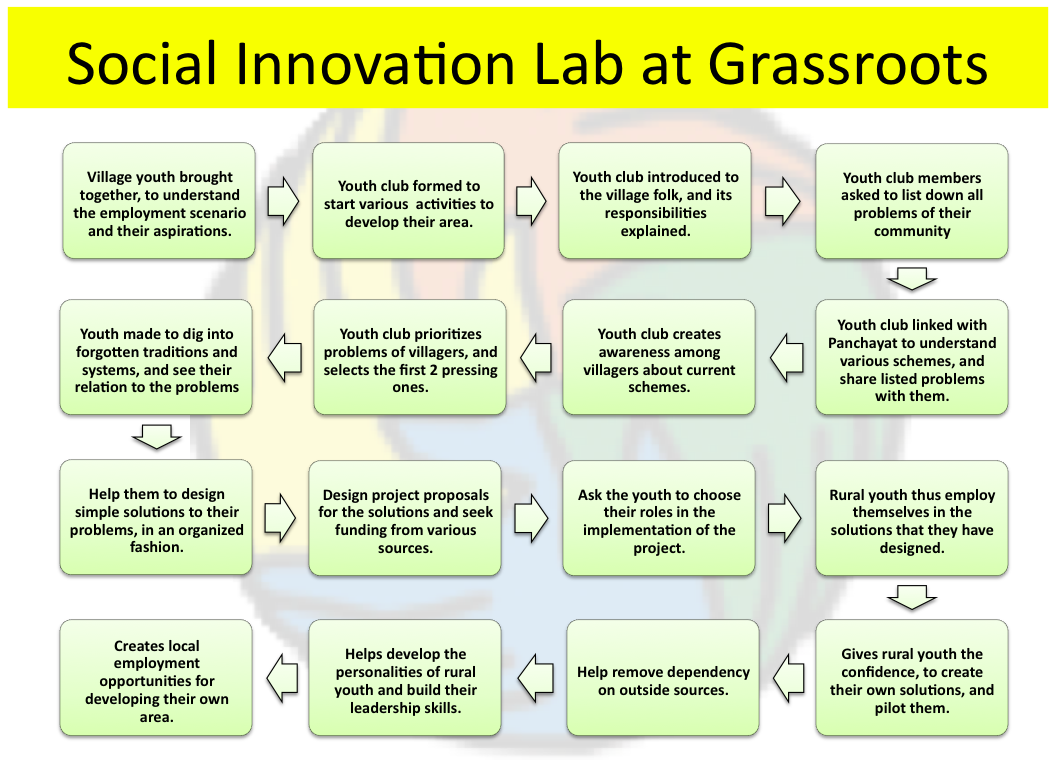
A SERA Lab brings rural youth and village elders to one table to map their own problems, skills and resources. Elders contribute forgotten, age-old practices that frequently turn out to be answers to today's problems. The solutions are written up as business plans for youth groups and taken to the village Panchayat for funding support under various government schemes.
NGOs working in rural areas should start Social Innovation Labs across village clusters, to empower village youth to create their own solutions. Such labs bring youth from different communities and villages together at regular intervals to discuss problems and possible solutions using the OASiS method of problem solving. The youth groups implement their own solutions, supported by the NGO with funding and other resources. The result is self-employment for the young people involved while their community's problems get solved, and an example set for neighbouring communities.
The guidance and support of the lab instils the confidence that they can solve their own problems, and build mechanisms for their own continued socio-economic development.