A community managed social security system that gives complete protection without taxes, premiums or savings. The first expenditure based model in the world.
A medical emergency should not be enough to destroy a family. For most of India's poor, it still is. CESS is a social security system that protects against the loss of life, health and livelihood, drawn entirely from spending people already do.
India has leapt toward developed status, but the majority still live without a safety net. State benefits reach mainly the organised sector, while 93 percent of the workforce, contributing 63 percent of GDP, works informally. Existing insurance is income linked and savings based, designed for those with a surplus and sold as a tax benefit, which makes it irrelevant for people who cannot make two ends meet.
Years of research led OASiS to a different insight: a model for the poor can work only if it does not squeeze their meagre resources, and if it leverages the advantage of a large population. So CESS funds security not through taxes, savings or spending cuts, but as a by product of a community's everyday, non discretionary expenditure.
The system builds complementary business activities for Self Employed Groups, formed out of Self Help Groups. Each group both produces and consumes within one integrated local business model, acting as sellers and buyers at once. As the community consumes, it earns free insurance cover against loss of life, ability, health, livelihood and old age. Every family holds a Personal Account for Social Security, a bank account that accumulates a security fund from their own consumption. The community even chooses its own insurance instruments and insurer. It is, in spirit, a Gram Swaraj model: of the people, by the people, for the people.
After a successful pilot in Betul, Madhya Pradesh, the model was replicated by Jai-Jui Vichar Manch in Solapur, Maharashtra. Two more replications are under way, by Drishtee in Bihar and by Proto Village in Andhra Pradesh. NGOs, community organisations, microfinance institutions and CSR teams are welcome to replicate it. Connected together across regions, such systems could form the social security net the country has long lacked.
The model received the Changemakers Innovation Award in 2006. It has been documented by Ashoka Changemakers and presented at an international research conference in Chennai in 2014, and covered by All India Radio.
The model has been documented independently, presented at an international research conference, and covered on national radio.
NGOs, community based organisations and microfinance institutions wishing to replicate the model for their beneficiaries are welcome. OASiS also offers the model to funding agencies and corporate houses to replicate under CSR, through their NGO networks. Interconnected community social security systems across different regions would create the social security net the country has long needed.
CESS has been implemented in two states, Madhya Pradesh and Maharashtra, and is planned in three more, Andhra Pradesh, West Bengal and Tamil Nadu. Two further replications are under way, by Drishtee in Bihar and Proto Village in Andhra Pradesh. The model has been acclaimed nationally and internationally, and received the Changemakers Innovation Award in 2006.
The model described above is the rural one, a Gram Swaraj system owned and run by the village. A parallel urban version of the consumption and expense based system has also been designed, adapting the same principle (security funded as a by-product of everyday, non-discretionary spending) to the different consumption patterns, service providers and settlement structure of a city. The first urban pilot registered 300 families and six service providers across two slums in Bhopal, with families opening Personal Accounts for Social Security and collections beginning through partner banks.
Organisations interested in either variant can write to us for the model documentation.
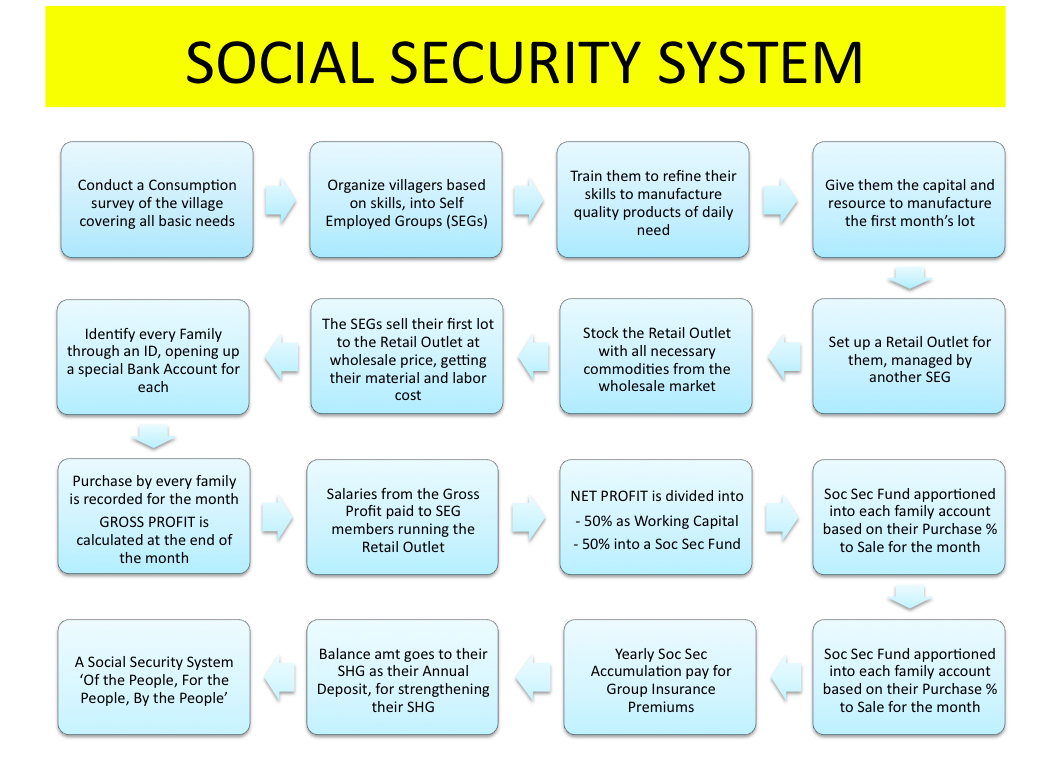
The full operating cycle, as run in Betul and replicated in Solapur.
Conduct a consumption survey of the village covering all basic needs.
Organise villagers by skill into Self Employed Groups.
Train them to refine those skills and manufacture quality products of daily need.
Give them the capital and raw material to manufacture the first month’s lot.
Set up a retail outlet for them, managed by another Self Employed Group.
Stock the outlet with all necessary commodities from the wholesale market.
The groups sell their first lot to the outlet at wholesale price, recovering their material and labour cost.
Identify every family through an ID, opening a special bank account for each.
Every family’s purchases are recorded through the month, and gross profit is calculated at month end.
Salaries are paid out of gross profit to the group members running the outlet.
Net profit is split in two: half as working capital, half into a Social Security Fund.
The fund is apportioned into each family’s account in proportion to their share of the month’s purchases.
The year’s accumulated social security pays the group insurance premiums.
The balance goes to their Self Help Group as an annual deposit, strengthening it.
Cover against loss of life, health, livelihood and old age, funded by spending the family was doing anyway.
A social security system of the people, for the people, by the people.
A campaign begun in 2005 led to India's first national health insurance framework for the disabled, co-designed with the Chief Commissioner Disability, The National Trust and IRDA.
Helps rural youth redesign sustainable local livelihoods together as climate change and automation erode farming and factory work, keeping communities and ecology intact.
A shared platform that brings community, university, corporate and government together to brainstorm and test solutions for long pending problems, at both grassroots and university level.
Whether you bring funds, a fresh idea, or an unsolved problem from the community you serve, there is a way in.